Regional Price Cap May Bring Relief to Negros Power Consumers
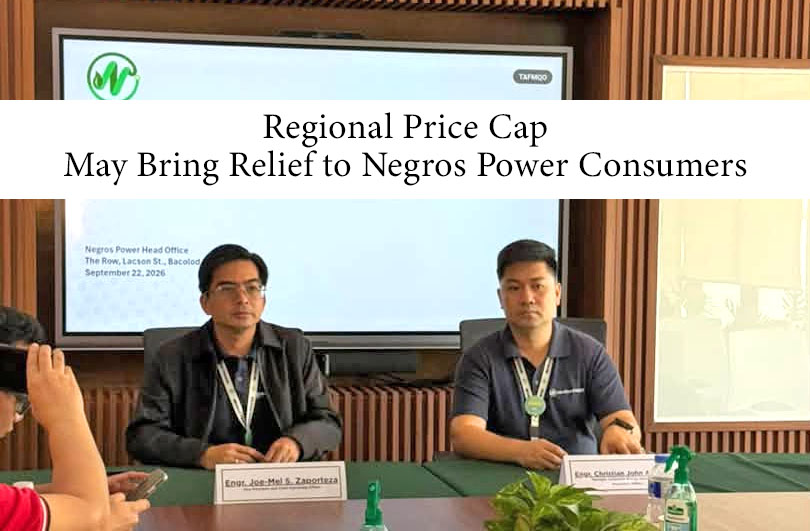
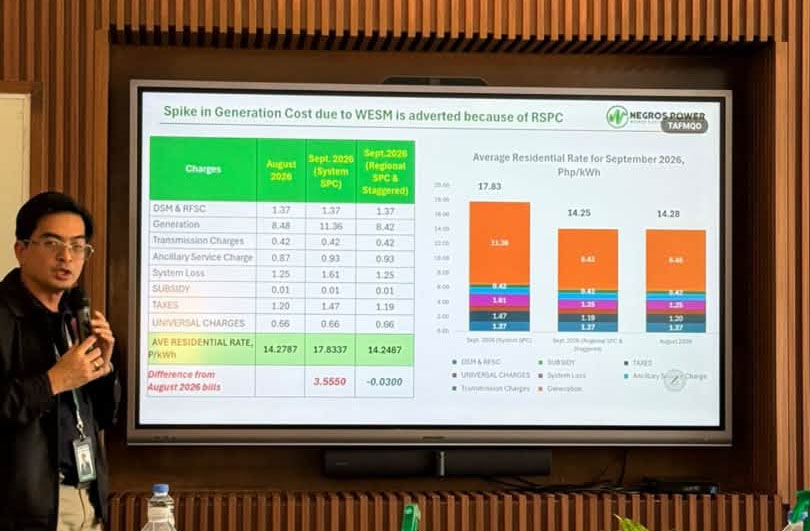
For electricity consumers in Bacolod and other areas served by Negros Power, the recent announcement on the Regional Secondary Price Cap (RSPC) may bring some relief to the high electricity costs recorded in August 2026. But consumers need to understand an important detail: a 54% or 56% reduction in WESM prices does not mean a 54% or 56% reduction in the total electricity bill.
What is the Regional Secondary Price Cap?
The Energy Regulatory Commission (ERC) issued an order on September 10, 2026, implementing the Regional Secondary Price Cap for the Visayas and Mindanao grids, retroactive to the August 2026 billing period.
The Regional Secondary Price Cap helps protect consumers from unusually high prices in the Wholesale Electricity Spot Market (WESM).
WESM is where electricity is bought and sold in the wholesale market. Prices can change depending on supply and demand, and periods of tight power supply can push prices significantly higher.
Under the ERC’s latest order, the regional price cap applies to the Visayas and Mindanao grids starting with the August 2026 supply month. The ERC has also advised distribution utilities to await the final August billing from the Independent Electricity Market Operator of the Philippines (IEMOP) before applying the corresponding adjustments.
According to the presentation by Negros Power Vice President and Chief Operating Officer Engr. Joe-mel Zaporteza, the ERC simulation showed that the average WESM price could have been reduced from ₱18.59/kWh to ₱8.47/kWh in the Visayas, equivalent to about a 54% reduction.
For Mindanao, the estimated reduction was about 56%.
Those numbers sound significant—and they are when looking specifically at WESM prices. But this is where the distinction between WESM prices and your total electricity bill becomes important.
Why your electric bill won’t drop by 54%
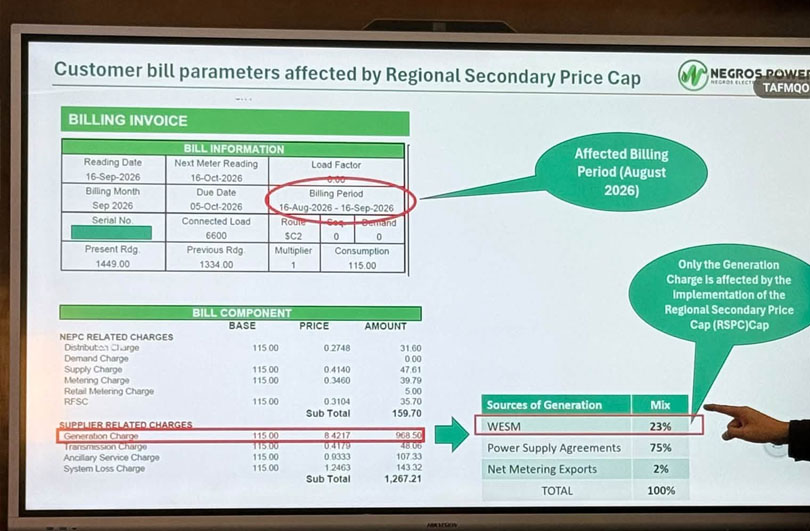
For Negros Power consumers, only a portion of the electricity supply comes from WESM.
Based on the Negros Power presentation, about 23% of its generation sources come from WESM, while approximately 75% comes from Power Supply Agreements (PSAs) and another 2% from net-metering exports.
This means the regional price cap applies only to the electricity that Negros Power purchased through WESM.
It does not apply to the entire generation charge, and certainly not to the entire electricity bill.
Your monthly bill also contains other components such as transmission, distribution, system loss, taxes and other regulated charges.
So when we hear that WESM prices could be reduced by 54% in the Visayas, it is more accurate to understand this as a reduction in the affected WESM portion of the generation cost, rather than a 54% reduction in the household’s total bill.
What does this mean for Negros Power consumers?
The practical effect will depend on how much of the electricity supplied to a particular consumer was exposed to WESM prices during the August billing period.
The high WESM charges from August will be recomputed following the ERC order, and the corresponding billing adjustments are expected to be reflected once the final calculations are completed.
In simple terms, the price cap is designed to shield consumers from the exceptionally high spot-market prices recorded during the period.
However, the peso amount that an individual consumer will actually save will vary.
A household whose electricity supply had greater exposure to WESM will have a different adjustment from one whose supply came mainly from contracted power sources.
A closer look at the August 2026 bill
This is why consumers should look beyond the headline percentage.
If your August electricity bill was unusually high, the regional price cap may result in an adjustment to the generation portion of that bill. But the actual reduction in your total amount due will be considerably smaller than the headline 54%–56% reduction in WESM prices.
The ERC has confirmed that the regional secondary price cap is being implemented retroactively to the August 2026 supply month.
Negros Power also publishes its generation charges and monthly rates for consumers to monitor.
What consumers should watch for
For Negros Power customers, the important thing now is to check the billing adjustment once the August 2026 recomputation is reflected.
Consumers can look at:
- The generation charge on their bill
- Any adjustment or recomputation related to August 2026
- Their total kilowatt-hour consumption
- The peso amount actually deducted or credited
- How the adjusted amount compares with the original August bill
The key takeaway is simple:
The Regional Secondary Price Cap can provide relief from high WESM prices, but it does not mean electricity bills will automatically fall by 54% or 56%.
For Negros Power consumers, the actual savings will depend largely on how much of the electricity supplied to them was sourced from WESM during the affected period.
And as the August 2026 billing adjustments are worked out, the actual peso savings on the bill—not the headline percentage—will be the number consumers should pay attention to.